
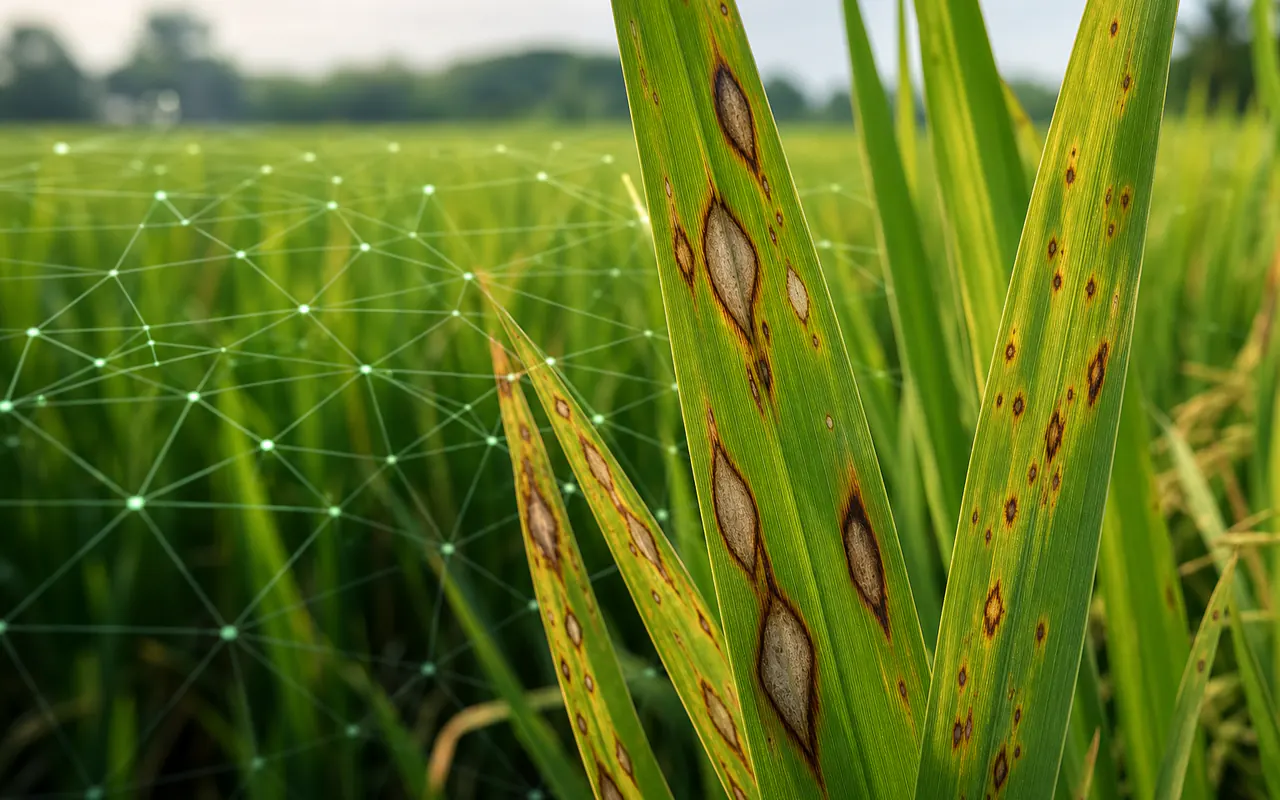
Five-Class Rice Leaf Disease Classification with EfficientNet-B4 & AlexNet
Abstract
A comparative study of Basic CNN, Modified AlexNet, EfficientNet-B0, and EfficientNet-B4 on a balanced five-class rice leaf dataset, Leaf Scald, Healthy, Brown Spot, Leaf Blast, and Rice Hispa, for automated paddy disease diagnosis.
Introduction
Rice is a staple that millions of people depend on, so protecting the crop matters enormously. Leaf diseases and insect damage can quietly ruin a harvest if they are spotted too late.
Checking fields by eye is slow and easy to get wrong. Image software offers a faster path: it can recognise common rice leaf problems from an ordinary photo, helping farmers act early. This project builds a system that tells apart the main rice leaf conditions from field pictures.
Problem Statement
Identifying rice leaf problems by hand is tricky, because many of them look alike:
- Some diseases show very similar spots and patches on green leaves.
- Scald-like margins can be mistaken for other stress.
- Insect scraping can look like disease discolouration.
- Early infection is subtle and easy to miss before it spreads.
Spreading expert knowledge across vast farmland simply is not realistic, so an automated helper is needed.
Objectives
- Tell apart the main rice leaf conditions: several diseases plus healthy, from photos.
- Start from a simple baseline model as a reference point.
- Compare it against stronger: more efficient models.
- See which approach is most reliable and practical for real use.
Dataset
The work is built around a balanced set of rice leaf images covering several disease types plus healthy leaves. Depending on the client, this can be a public agriculture benchmark, licensed or private field photos, images from other trusted sources, or a custom set collected for the project. Images are cleaned, normalised, balanced across conditions, and lightly varied before training.
Methodology
The project trains and compares four image models on the same prepared data: Basic CNN, Modified AlexNet, EfficientNet-B0, and EfficientNet-B4, from a simple built-from-scratch baseline through to more efficient, modern designs.
The value here is practicality. Rather than only chasing the highest score, the project weighs accuracy against how much computing power each model needs, pointing toward a design that is reliable enough to trust yet light enough to eventually run on a phone in the field, where farmers actually need it.