
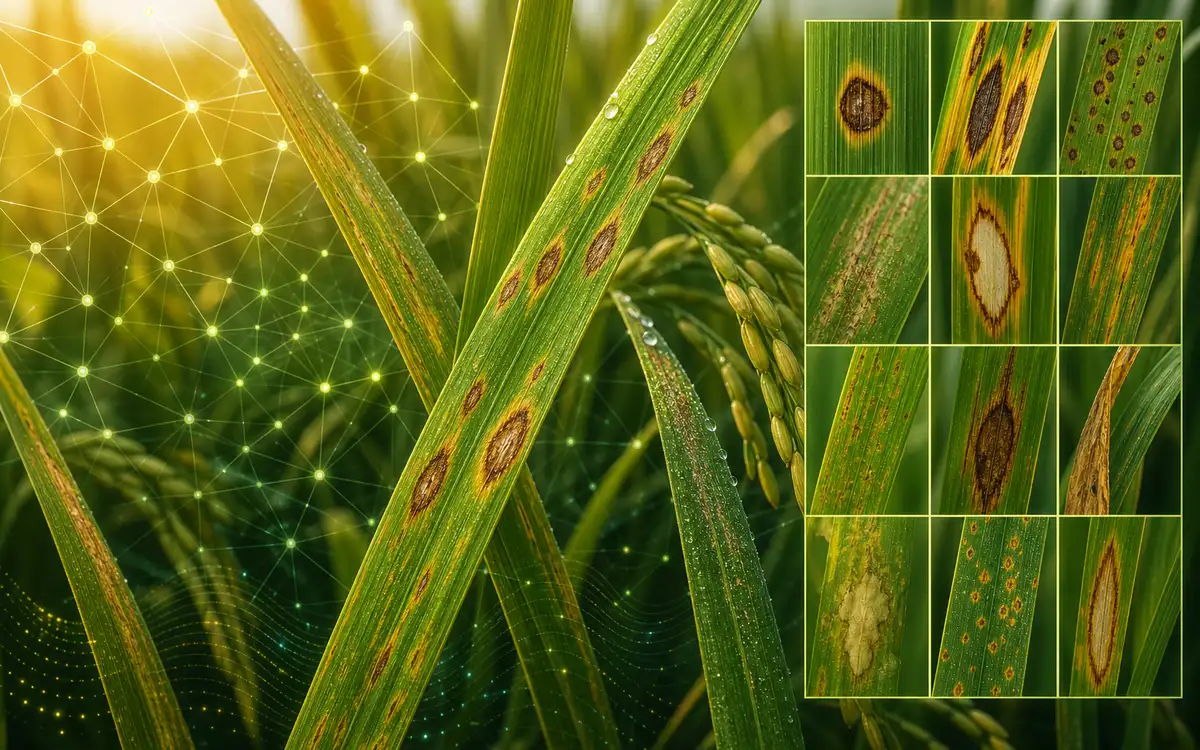
Rice Leaf Disease Classification with AlexNet Snapshot Ensemble & Hybrid ViT
Abstract
A comparative study of deep learning architectures on rice leaf imagery, modified AlexNet with snapshot ensembling, Hybrid ViT, EfficientNet-B4, VGG16, and Inception V3 across ten disease and healthy classes.
Introduction
Rice feeds a huge share of the world, so keeping the crop healthy is vital. Leaf diseases can spread quickly and wipe out a harvest before farmers even notice the early signs.
Inspecting fields by hand is slow and easy to get wrong. Image software can recognise rice leaf problems from ordinary photos, turning what a farmer sees into a quick, useful diagnosis. This project builds a system that tells apart a wide range of rice leaf conditions from field images.
Problem Statement
Spotting rice diseases by eye is error-prone, because many of them look alike:
- Several blast and scald types share very similar lesions on overlapping leaves.
- Different spot diseases differ only in subtle colour and texture.
- Some infections show overlapping: confusing signs.
- Insect damage can be mistaken for disease.
Spreading expert knowledge across vast farmland is unrealistic, so a reliable automated helper is needed.
Objectives
- Tell apart many rice leaf conditions: several diseases plus healthy, from field photos.
- Compare a range of approaches: from a simple baseline to more advanced designs.
- Explore ways to make the models steadier and more reliable.
- Identify which approach best balances accuracy and practicality.
Dataset
The work is built around a balanced set of rice leaf images spanning many disease types plus healthy leaves. Depending on the client, this can be a public agriculture benchmark, licensed or private field photos, images from other trusted sources, or a custom set gathered for the project. Images are cleaned, normalised, balanced across conditions, and expanded with standard variations before training.
Methodology
The project trains and compares several image models on the same prepared data: AlexNet Snapshot Ensemble, Hybrid ViT, EfficientNet-B4, VGG16, and Inception V3, from a simple baseline through to more advanced and combined designs.
The novelty lies in going beyond a single model: it explores a technique that gathers several "snapshots" of a model during training and blends them for steadier results, alongside an approach that mixes complementary methods to capture both fine detail and the bigger picture of a leaf. The aim is reliable recognition across many look-alike conditions, while keeping an eye on what could realistically run in the field.