
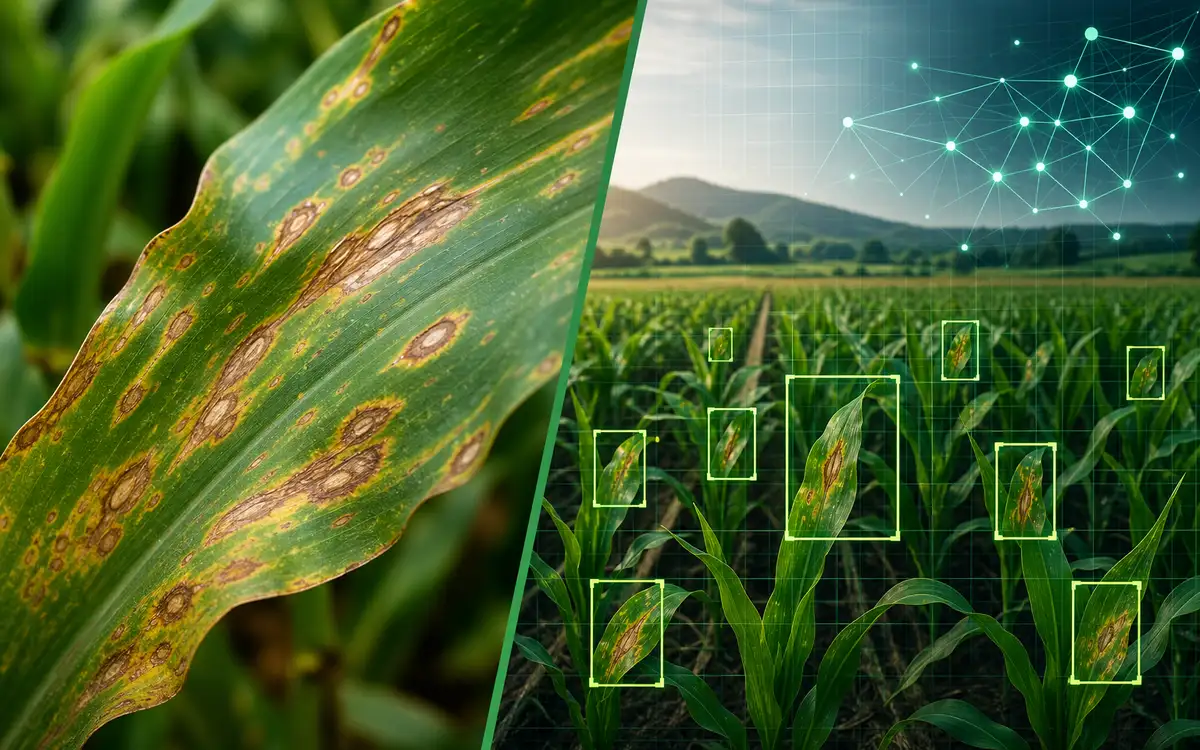
Plant Disease Detection with Optimized YOLOv8, GhostNet & Coordinate Attention
Abstract
A comparison study on real-field plant disease detection, enhancing YOLOv8n/s with GhostNet backbone compression and Coordinate Attention across multiple plant species and disease classes.
Introduction
Farming feeds nations, yet crop diseases quietly eat into harvests, push up food prices, and leave growers guessing about the right treatment. Catching disease early, from an ordinary photo of a leaf, can make a real difference.
Image software can now spot signs of disease on leaves from everyday field photos. This project builds a detector that finds diseased leaves in real-world pictures, with a strong focus on staying light enough to run on modest, affordable hardware.
Problem Statement
Diagnosing plant disease by hand is slow, subjective, and costly, and automated systems face their own hurdles:
- Models trained on clean studio photos often fail on messy: real field images with natural light and clutter.
- Real-world image collections tend to be small and uneven across disease types.
- Tiny disease spots and overlapping leaves are hard to pick out.
- Running on a phone or low-cost device means the model must stay small without losing accuracy.
- Flagging a healthy leaf as diseased wastes pesticide and erodes trust.
Objectives
- Build a detector that finds diseased leaves in natural field photos.
- Make the model lighter so it can run on modest hardware.
- Help it focus on the disease-relevant parts of a leaf.
- Prepare and expand a small: uneven image set so the model learns well.
- Compare setups to find the best balance of accuracy and efficiency.
Dataset
The work is built around a set of real-world leaf images covering several crops and disease types photographed in natural conditions. Depending on the client, this can be a public field benchmark, licensed or private photos, images from other trusted sources, or a custom set collected for the project. Because such collections are often small, the images are cleaned and heavily expanded with standard variations before training.
Methodology
The project starts from YOLOv8n/s and makes it leaner and more focused: a GhostNet backbone trims the model so it needs less computing power, and Coordinate Attention helps it zero in on the diseased parts of a leaf. Careful preparation and data expansion help it cope with messy, real-world photos.
The novelty is delivering field-ready accuracy on a tight budget. Instead of chasing top scores with a heavy model, the design keeps things light enough for low-cost devices while staying focused on the disease itself, a practical fit for farmers who do not have powerful hardware.