
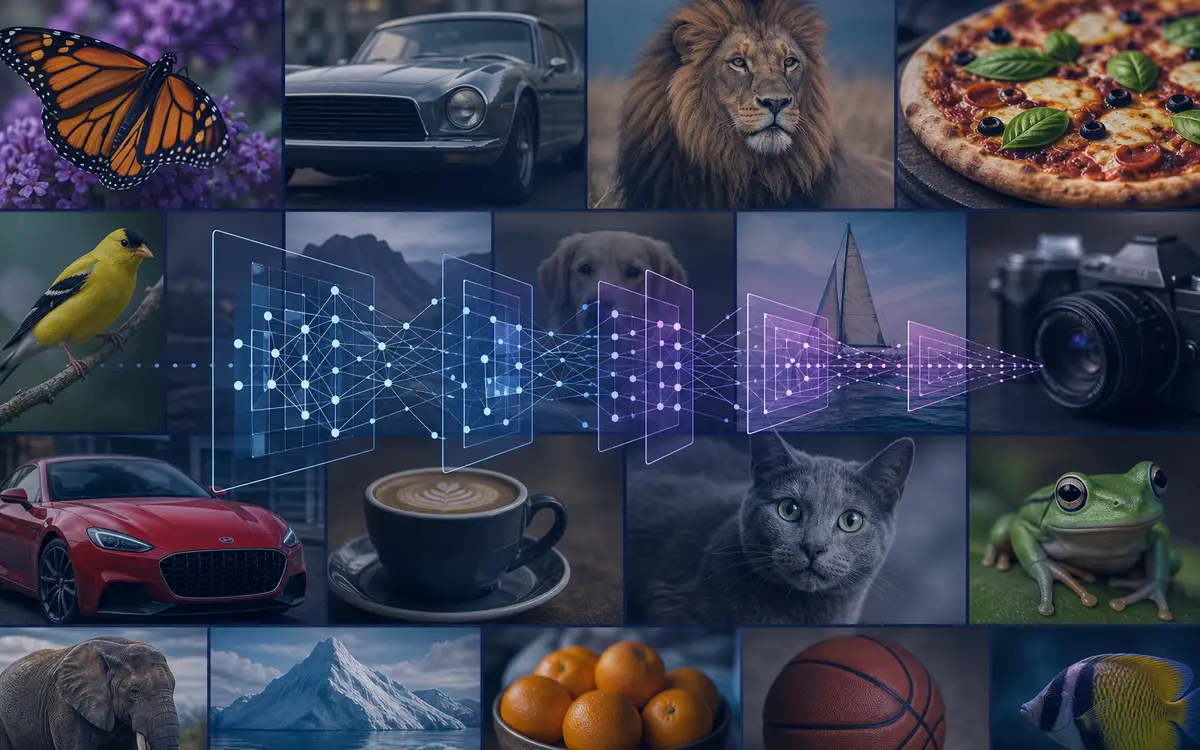
CNN Architecture Comparison for Image Classification
Abstract
A deep learning benchmark of CNN architectures, from a custom Basic CNN to pretrained DenseNet-121, VGG-19, ResNet50, and Modified AlexNet, with transfer learning, augmentation, and full performance analysis.
Introduction
Getting computers to recognise what is in an image sits at the heart of modern vision technology, powering everything from self-driving cars and medical imaging to photo search and monitoring tools. Over the years, many different model designs have been proposed to do this well.
That leaves a very practical question for anyone building such a system: which design actually works best when data and computing power are limited? This project answers that by putting several well-known image models head to head on the same task.
Problem Statement
Choosing the right model is not obvious, because several factors pull in different directions:
- Bigger: deeper models can learn more but need far more computing power.
- Reusing knowledge from a model already trained on millions of images can help: but not always.
- The common belief that these systems need huge amounts of data is worth testing.
- Telling apart look-alike categories (say: a butterfly and a dragonfly) challenges any model.
- Limited hardware restricts what can realistically be trained.
Objectives
- Compare several well-known image models on the same recognition task.
- See how much reusing pre-trained knowledge actually helps.
- Understand how a model's size and depth affect its results.
- Use simple data-expansion tricks to get more out of a modest dataset.
- Judge the models fairly using clear: side-by-side measures.
Dataset
The work is built around a set of labelled images spanning a handful of everyday categories. Depending on the client, this can be a public image benchmark, licensed or private images, pictures gathered from other trusted sources, or a custom set collected for the project. The images are resized, normalised, and lightly expanded with standard adjustments so a modest collection goes further.
Methodology
The project trains and compares five image models on the same prepared data: Basic CNN, Modified AlexNet, ResNet50, VGG-19, and DenseNet-121, from a simple built-from-scratch network through to larger designs that reuse knowledge from earlier training.
The value here is turning a confusing set of options into clear guidance. Rather than assuming the biggest model always wins, the project weighs simple designs against richer ones and tests whether reused knowledge and smart data expansion can make a modest dataset go a long way, helping a team pick the right-sized model instead of the most expensive one.